Saturday, 5 October 2013

Homes Fit For Heroes - Bill Brandt

Between 1939 and 1943, Bill Brandt undertook a commission from the Bournville Village Trust to photograph housing and living conditions in Birmingham. The images contrasted life in the 19th century built back-to-back slums of the inner city with the modern municipal housing built in the 1930s.


Brandt manipulated the composition and lighting to intensify the contrasts. The modern home is flooded with light and air, whilst the family eats good food, some of which will have been grown in their own garden. In the slum housing there is little light and the food on the table is meager, but Brandt is careful not to denigrate the family in any way, they are just as hard working and loving as the more fortunate parents. Interestingly Brandt had suffered from TB in his childhood and would have understood too well the importance of fresh air and sunlight.

The photographs were never used and lay undiscovered in the BVT archives for 60 years before going on display again in Birmingham.

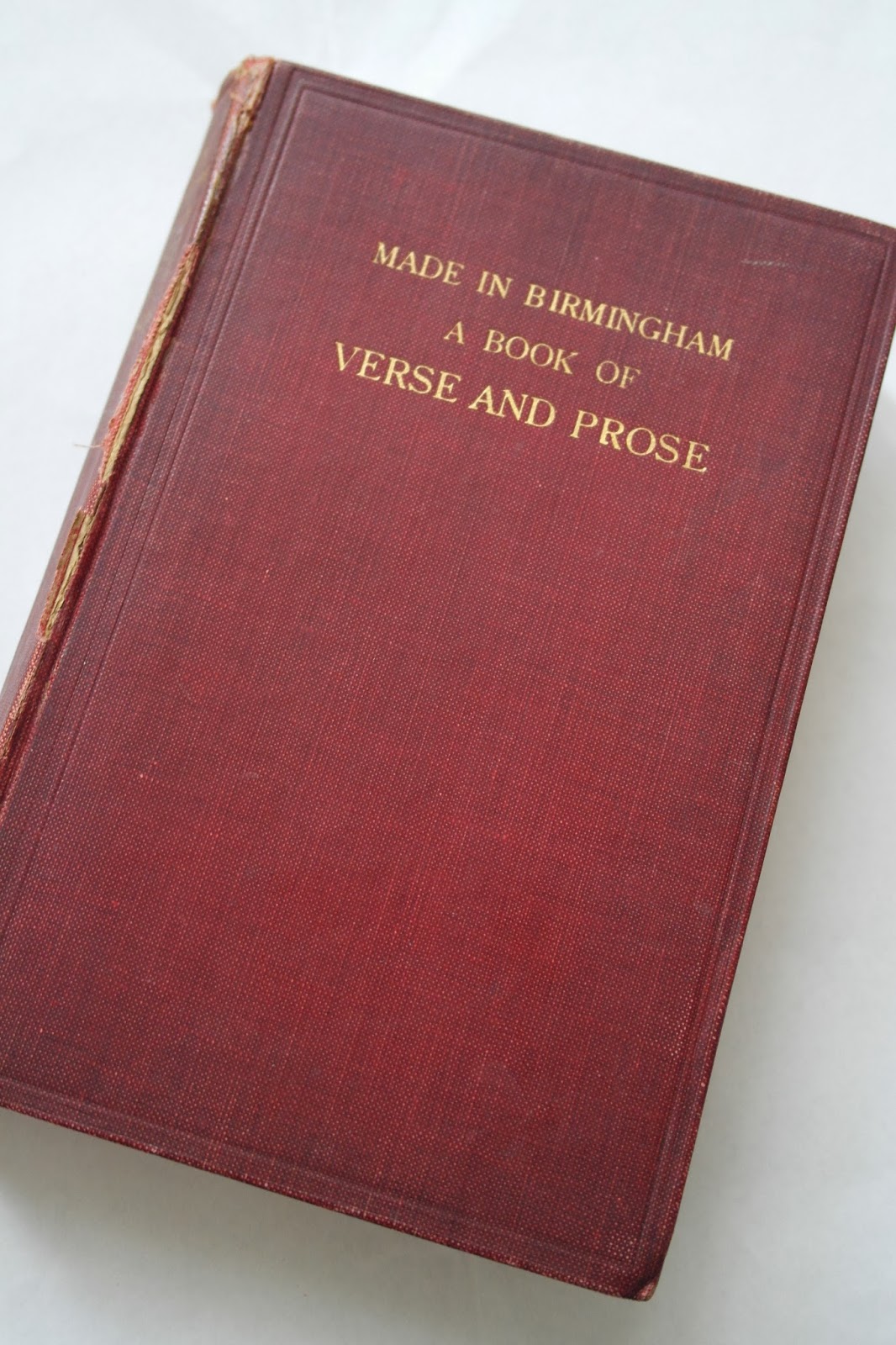
'Made in Birmingham - A Book of Verse and Prose'


A few months back I found a little book in the Oxfam shop in Kings Heath. Published in 1916 it contains poems, short essays and articles written by notable figures from Birmingham. Edward Burne-Jones, Joseph Chamberlain, Cardinal Newman and Joseph Priestley are a few names that I recognised. Of particular interest are the entries attributed to members of the Cadbury family. There is an article by George Cadbury about Adult Schools, his wife Elizabeth has two entries, one about encouraging a more spiritual approach to life and the other about the worrying rise of German Materialism. But the most significant contributions, in my opinion, are from Edward Cadbury. Unfortunately there are no dates attached to the entries, but I am assuming this Edward Cadbury is George's eldest son. As well as his involvement with the family business, he had a long association with the newspaper industry, which he used to publicise a variety of causes. He has been credited with directly influencing the introduction of the Old Age Pension Act and the Trade Board Act which aimed to improve the working conditions of women.

The first article is entitled 'Idealism in Labour', in which he outlines the basic philosophy of the Cadburys as employers.


The second, and most radical I feel, is called 'Casual Labour' (it was co-authored with G.Shann - they seemed to have worked together on educational handbooks for the Adult Schools). He is writing about many of the issues that still dominate political debate today.


No doubt, depending on a contemporary reader's political persuasion, different interpretations can be drawn from aspects of this text. However he clearly warns against "unrestricted competition" and there is no mistaking Edward's intentions in the following passages:

"When the labourer cannot maintain himself at a reasonable standard of decency and comfort, the decline in industrial efficiency is rapid."

"We must recognise that any trade that does not pay a living wage to its workers is a parasite on the community"

The Cadbury Sisters and Moseley Park


Back in early September I saw the lovely Cadbury Sisters perform at Moseley Folk Festival (see previous post 6/9/2013). When introducing them, the Festival Compare Janice Long said that they were related to a previous owner of Moseley Park - the venue for the festival. The sisters said that they had not known that - which I found surprising in itself.


Due to my interest in Moseley Park, I decided to look at the history of the Cadbury connection. Richard Cadbury lived in Moseley Hall with it's extensive grounds which included the Lake. In 1892 he gave the Hall to the Children's Hospital Committee, so that it could be used as a hospital and convalescent home for under privileged children from Birmingham.


The map above is from 1888 when Richard Cadbury and his family still occupied the Hall. The centre of Moseley is in the middle of the image with the Park to the left and the rapidly expanding suburbs on all other sides.

The map below is from 1902. Moseley Hall can be seen as 'Convalescent Home for Children' and the Park has been cut in half by the newly constructed Salisbury Road (1896). More housing is encroaching on the northern section of the Park with just the lake (labelled as Fish Pond) and some woodland surviving.


A group of local businessmen got together to save the Park and prevent the lake from being filled in to build more houses. Moseley Park and Pool was officially opened in 1899. It survives today by private subscription, but is open regularly to the public, for festivals and local school visits.

Gifting the Hall as a hospital cost Richard Cadbury £30,000, which in today's terms would be approximately £3 million. He and is family moved to nearby Uffculme Hall, which was later also given up to be an Open Air School for children with TB. Thousands of children from inner city Birmingham were treated at Uffculme. The Cadbury Family still own the lease on Moseley Hall. The NHS pay a peppercorn rent for it's continued use today.


Bournville Village

In 1879 George and Richard Cadbury moved their family chocolate making business out of the centre of Birmingham to 4 miles outside the city. They began to build homes for their workers, moving them out of the city slums, known as 'back to backs', into well designed homes with pleasant gardens. This became the Bournville Village Trust, which still exists to maintain the original ethos of the Cadbury brothers. Last Saturday I visited Bournville to take some photographs and collect research.


 The school buildings are on an impressive scale which reflects the Cadburys' strong belief in a good education for all.


 The attention to detail, on even the smaller houses is very noticeable. Short cuts such as cheap mass produced doors and windows have not been used to save money. There are many different styles and shapes. Even where common elements are used, they are presented in different ways, to ensure each house appears to have an individual style.


The larger homes have even more individual features such as overhanging eaves and dutch style gables.


Monday, 23 September 2013

MA Art & Design Introduction

BA Graphic Design in the 1970's - The 'Olden Days'.....


Working in Information Graphics in the 1980's......


 Teaching for 21 years - little time for own work.....


Great Art Room  - wonderful colleagues - lovely students....


Upping sticks back to Birmingham, Moseley to be precise.....


Digging deeper into the past......


Friday, 6 September 2013

Library of Birmingham

 The new Library of Birmingham is the biggest in Europe and opened on Tuesday 3rd September. The interior is impressive and the roof terraces are stunning.


Moseley Folk Festival 2013

Moseley Park hosted the annual folk festival from August 30th to September 1st.