Showing posts with label Print. Show all posts
Sunday, 16 October 2016
Lino Cut Workshop at Winterbourne
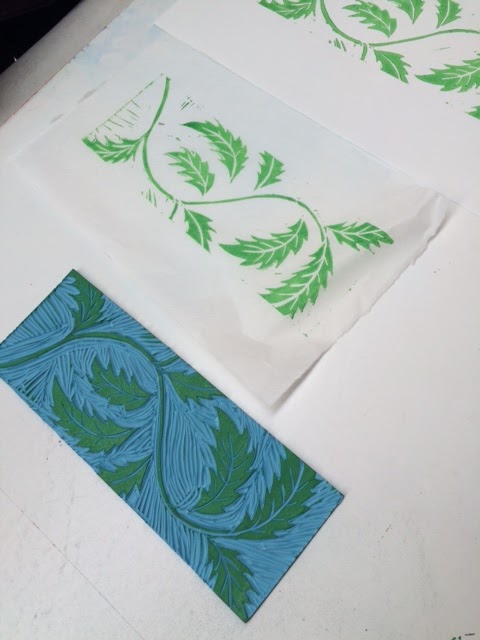
I ran a workshop today at Winterbourne in the Old Tool Shed and had some lovely folks attend. We were looking at the Kelmscott Chaucer borders, the plaster details in the house and, using plants from the garden as inspiration, we created some unique lino cuts.
We started by looking at the honeysuckle design that runs along the length of the hall. Everyone transferred that on to lino and then cut it using their own interpretation.
Then, after a trip round the garden, everyone came up with their own designs.
Sunday, 14 August 2016
More on the second Winterbourne Lino - 'Return from the West Indies'
I am now making progress on the second lino. This one depicts Margaret's return from her trip to the West Indies in 1907. This is the entry in her diary-
'A very fine voyage home with bright sun and a following wind. Arrived at Southampton Monday March 4th. This was a homecoming whose pain was unspeakable. My little Robert Francis died peacefully on March 2nd. And I will not forget my husband came to meet me and to share the agony of those first moments. And when I reached home, I found my children'.
Although she doesn't mention the name of the ship, previous diary entries talk about sailing out on the SS Thames, a Royal Mail Steam Packet, two months earlier. I therefore assume she must have come back on a similar vessel.
This is an image of the Thames that I have found. It is a twin funneled masted vessel. In order to get an image of the ship from the perspective that I need, I then looked at similar vessels and found this image of the Amsterdam, which was from the angle that I needed.
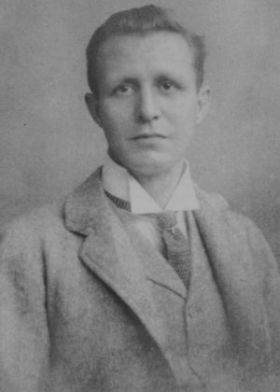
My idea is to show John standing on the dock at Southampton waiting for Margaret's ship to arrive. The images that I have of John show head and shoulders views from the front as you would expect. He is faired haired and clean shaven.
I needed to find an image that I could use to show John facing out to sea. The one I decided to use was from 'Parades End'.
The clothes proved very difficult to research as men's fashions are not as well recorded as women's. However I did find this image of men's outerwear from the right period. I also needed John to stand out against the dark clouds around him, so I went for the check coat from 1906.
Friday, 4 March 2016
Printing the first Winterbourne Lino
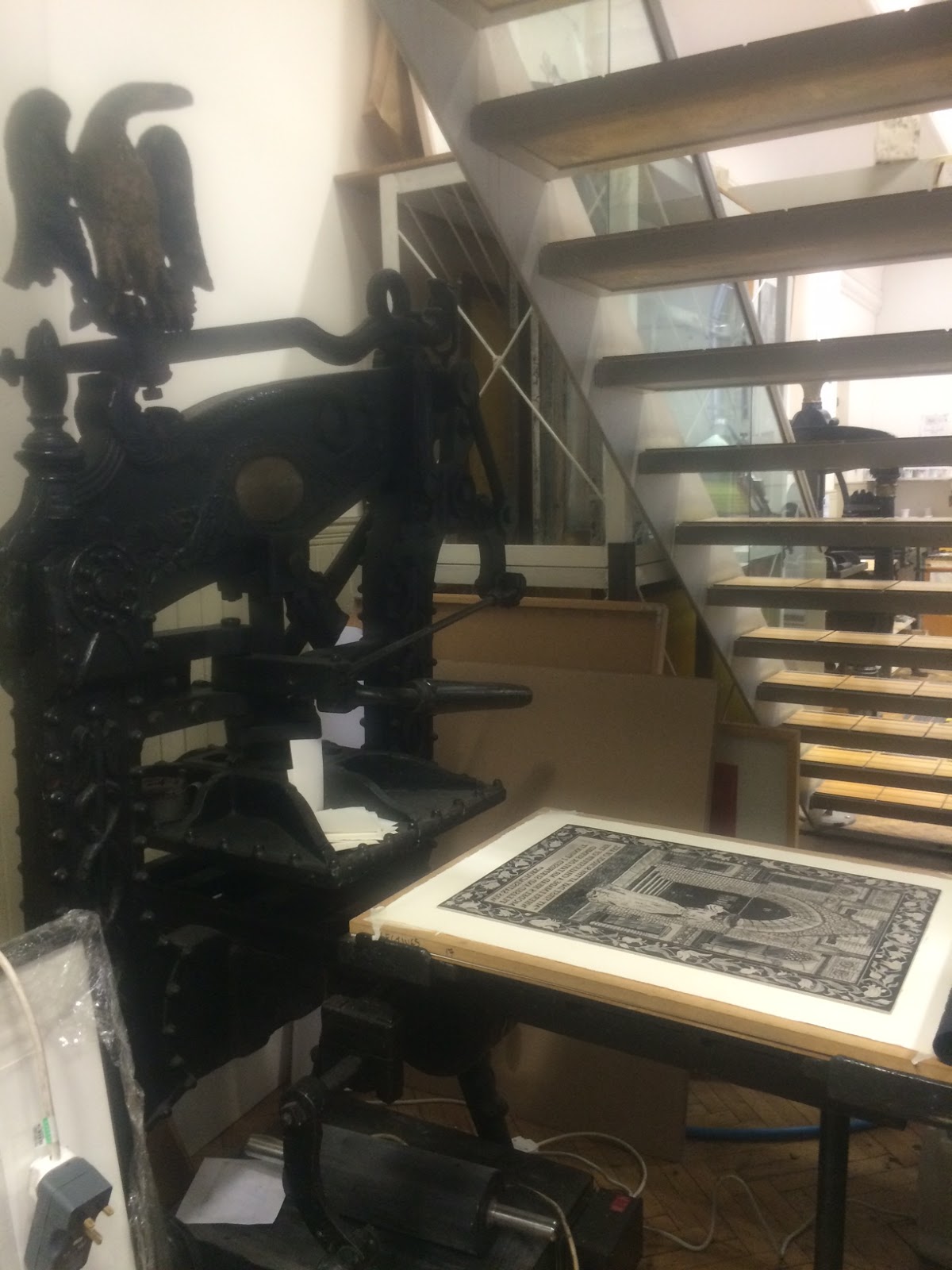
After finally finishing cutting the first of the Winterbourne linos, I was able to pop into Margaret Street today to proof it. This seemed appropriate as the print features the front entrance of the School of Art. It's an exciting thing to ink up a lino that you have been working on for such a long time. You finally see it as you have been imagining it to look - and hoping you don't spot any mistakes!
I wanted to use cotton based papers to emulate the Kelmscott Press works that I have seen. After having sort advice from the lovely folks at John Purcell Papers, I decided to try Velim Arches and a Zerkall paper. I tried the Velim both damp and dry using the Columbia Press. I also hand burnished onto Tosa Washi.
I'm pretty pleased with these first proofs.
Thursday, 14 January 2016
Update on Winterbourne Project
I had to shelve the Winterbourne project for a few months due to a family illness, but I have recently started cutting the first lino again and I'm aiming to try and get this first one proofed by the end of this month.
Saturday, 22 August 2015
Cadbury Research Library
I have not been able to blog much of the material that I have sourced during my research for the Winterbourne Project as I am only allowed to photograph for my own purposes. This has included the letters, diaries and photographs of the Nettlefold family in Winterbourne's own archives. Yesterday I visited the Cadbury Research Library at Birmingham University to look at their extensive collection of books published by William Morris's Kelmscott Press. Although it wasn't possible to photograph the books on this occasion I wanted to record my thoughts on seeing them 'in the flesh'. The images here are sourced from a google search.
What struck me most was the intensity of the ink, the beautiful texture of the handmade rag paper and the impression made on the back of each page by the relief print. The use of spot red was very noticeable throughout the books - a device used in religious books from previous centuries. The binding of the books was also of great interest to me. Many were encased in limp vellum with ribbon ties- again another technique inspired by medieval bookbinders.
I also saw publications inspired by the Kelmscott Press. Arthur Gaskin, an artist and jewellery designer from Birmingham, illustrated 'Good King Wenceslas' for Cornish Bros. of New Street.
What struck me most was the intensity of the ink, the beautiful texture of the handmade rag paper and the impression made on the back of each page by the relief print. The use of spot red was very noticeable throughout the books - a device used in religious books from previous centuries. The binding of the books was also of great interest to me. Many were encased in limp vellum with ribbon ties- again another technique inspired by medieval bookbinders.
I also saw publications inspired by the Kelmscott Press. Arthur Gaskin, an artist and jewellery designer from Birmingham, illustrated 'Good King Wenceslas' for Cornish Bros. of New Street.
Tuesday, 7 July 2015
'Winterbourne Stories' - first drawing
These aren't great photos, but they show the first drawing for the linos that I am doing for the 'Winterbourne Stories' project. There will be approximately 10 A2 sized lino prints inspired by the Kelmscott Chaucer in style. Each one will illustrate an episode in the life of the Nettlefolds, which helped form Winterbourne House as it is today.
This first drawing onto tracing paper shows Margaret Chamberlain, before she married John Nettlefold, on her first day at Birmingham School of Art. She wrote in her diary of 1890 about the classes she attended at the Margaret Street building, which would have been opened about 15 years by this time. It was designed by John Henry Chamberlain (no relation) who had also designed Highbury Hall (the home of Margaret's uncle Joseph). The floral decorative detail was influenced by the writing of John Ruskin - champion of the Arts and Crafts Movement.
The image has been drawn from recent photographs I took of Margaret Street and an archive image of a young woman from around 1890.
The design of the illuminated border will be based on lilies, as these feature heavily in the decoration of the Art School's facade. There is a large stone carved roundel and terracotta panels that all show various kinds of lilies. I also feel the lilies are appropriate to Margaret's unmarried status at this time.
The image has been drawn from recent photographs I took of Margaret Street and an archive image of a young woman from around 1890.
The design of the illuminated border will be based on lilies, as these feature heavily in the decoration of the Art School's facade. There is a large stone carved roundel and terracotta panels that all show various kinds of lilies. I also feel the lilies are appropriate to Margaret's unmarried status at this time.
Tuesday, 30 June 2015
A New Project
I have spent some time over the last few weeks rummaging about in the archives at Winterbourne House. This lovely Arts and Crafts house, which now belongs to Birmingham University, was built by the Nettlefolds as a family home. John Nettlefold was from a family of industrialists (the 'N' in GKN) and his wife Margaret was part of the Chamberlaine family. The archives contain diaries, letters and photographs that give wonderful insights into their relationships, work and family life.
Of great interest to me is the small print facility that is housed in one of the out buildings. In recent weeks this has been reorganised and now consists of a print room with several presses and a composing room that houses a collection of Letterpress.
My idea is to create a series of prints that are based on the story of the Nettlefolds at Winterbourne. They will echo my Moseley Stories project, but this time would use lino cut and wood engraving techniques instead of copper plate etching to enable me to print them at Winterbourne. One of the influences for the visual style of the prints will be the Kelmscott Chaucer designed and printed by William Morris and illustrated by Edward Burne-Jones. There is a copy of the book on display at Winterbourne.
There is also a strong link to John Byam Liston Shaw, a follower of the Pre-Raphaelites, whose work 'Boer War' (1901) has always been one of my favourite paintings in Birmingham Museum and Art Gallery. Byam Shaw painted several portraits of the Nettlefold family including a lovely full length study of Margaret standing at the dining room window.
There were several books in the archives that had been illustrated by Byam Shaw, including a Tales from Shakespeare. I intend to use his style of illustration as an influence for my prints.
I have already produced an initial wood engraved illuminated letter as a starting point. The letter M is surrounded by bleeding heart which grows in the gardens at Winterbourne. I combined this with some letterpress. The combination didn't really work as the text is too large. But it does give an indication of the overall idea.
Subscribe to:
Posts (Atom)