Showing posts with label Photography and the Archive. Show all posts

Tuesday, 1 July 2014

'Significant Features' Evening Event

This evening we staged an event at Bournville. A discussion chaired by Mike Dring from the BCU School of Architecture with special guests,  Peter Larkham - Professor of Planning at BCU and specialist in the development of cities after WW2 and Christopher Timothy - Independent Town Planner whose family contributed to the original Bill Brandt photographs commissioned by BVT in the 1940's.


There was a really good turn out and lively discussion throughout.

Wednesday, 25 June 2014

'Significant Features' Private View


My mirror was displayed leaning against the wall which resulted in some interesting reflections during the afternoon as the sun came through the skylights.


Final day of preparation for 'Significant Features'

The floor has been cleaned and sealed and looks fantastic - well worth having to wait a day for it to be done.


Next the projection booth arrives which Matt has prefabricated and is assembled on site.


Cheryl works on the floor plan earlier in the day. Ross makes last minute adjustments to the lights.


Tuesday, 24 June 2014

Installing 'Significant Features' at Bournville

Over the last few days we have been preparing the gallery space for the exhibition. A large number of boards needed to be removed from the walls and floor. The walls had to be filled and then painted.


 Matt, who is fabricating the exhibition furniture, as made two tables to display books, screens for photographs and a projection booth.


Ross and I have agreed on a lay out which he is drawing up ready for a floor plan to be printed as an exhibition guide.

Saturday, 10 May 2014

Visit to Bournville Exhibition Space


On Friday those of us involved in organising the 'Significant Features' exhibition went to see the exhibition space at Bournville. We were able to present our ideas for the exhibition to the rest of the team and to discuss plans for the next few weeks. The layout of the show will be themed around aspects of the survey 'Social Mix' .We measured up the space and Ross has produced a floor plan for us to finalise the lay out.


Saturday, 29 March 2014

'Significant Features'

Some months ago I got involved in planning an exhibition of the work produced during the 'Photography and the Archive' module (see previous posts). MA and BA Art and Design and students from the School of Architecture responded to aspects of the Bournville Village Trust Archive. After several meetings, we are now starting to make some decisions about the exhibition which will be entitled 'Significant Features'. A curatorial statement has been written:

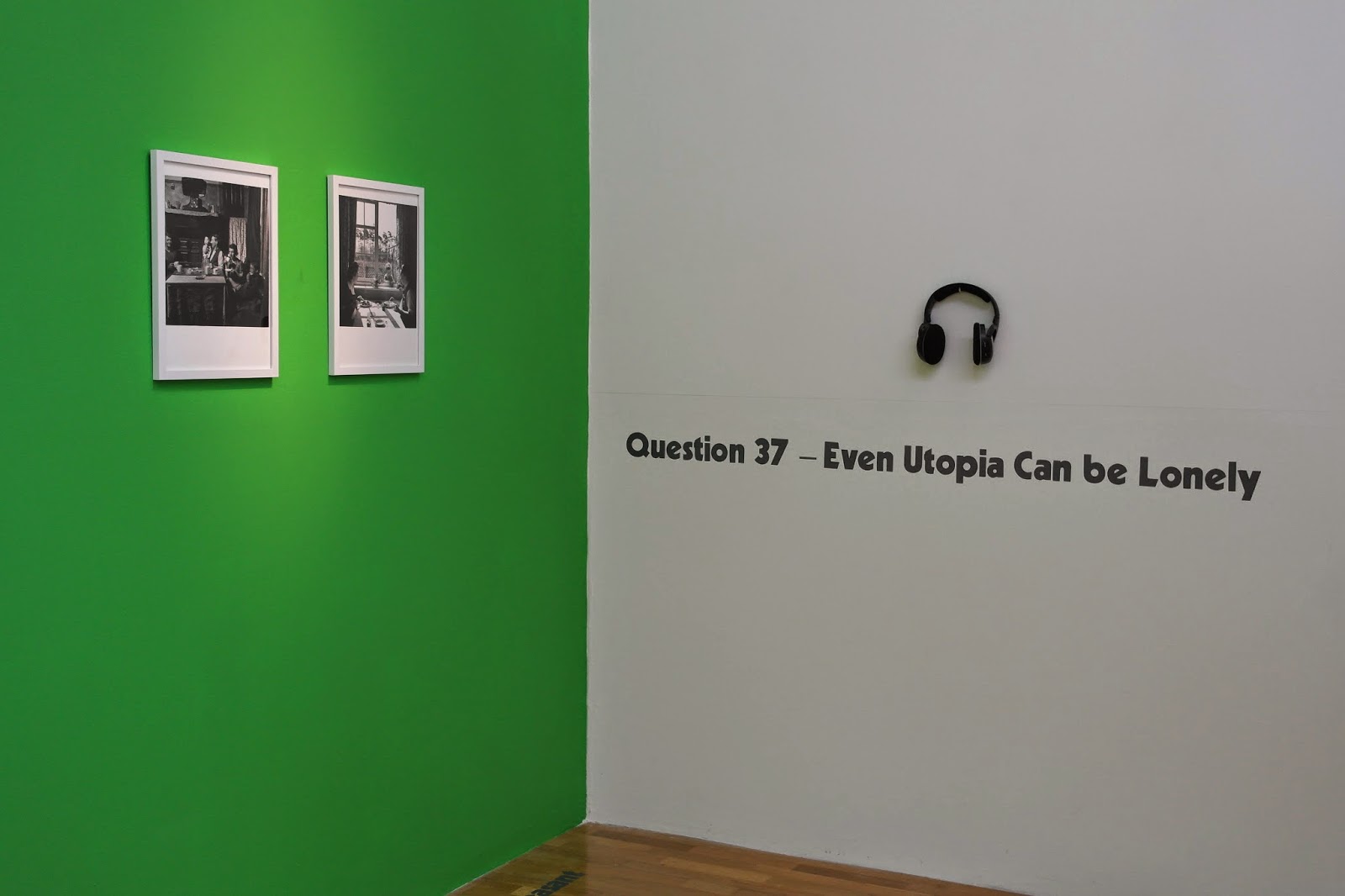
Significant Features has been curated in response to a study of Wendy Sarkissian’s book Social Mix: The Bournville Experience. It was published in 1978 by Bournville Village Trust to find out how Bournville’s residents found living in the model village.

The exhibition will bring together work by students at BIAD, along with contemporary responses to questions that Social Mix poses and material from Bournville Village Trust’s archive, to explore aspects of the residential experience, ideas of ‘home’ and what it is that creates a sense of community.


As well as selecting artworks, we also hope to exhibit material from both the Cadbury Archive and the Bournville Village Trust Archive. Yesterday we started to consider the layout of the show, grouping work to link with statements from the original source publication 'Social Mix'.


One other plan is to create an interactive survey map based on people's ideas of home and community. An inspiration for this comes from a display at 'Birmingham Made Me Expo' a couple of years back.


We also hope to get hold of a copy of 'When We Build Again' a film commissioned by BVT. A clip from the film can be seen here.

Tuesday, 31 December 2013

Photographing the printed mirror out on site

Last Sunday, when it was relatively quite in the city centre and there was also a break in the bad weather, I took the mirror to the two locations I had previously researched as sites of early Cadbury factories. My aim was to photograph the mirror in these locations, not only surrounded by businesses that reflect the current economic climate and the lack of progress since Edward Cadbury's time, but also to show reflections of these businesses in the mirror itself.

In the Dale End/Bull Street/High Street location (formally Crooked Lane) there are pawnbrokers, payday loan companies, pound shops and the ubiquitous fast food outlets that offer only minimum wage and operate zero hours contracts. It was very cold and, whilst not as windy as in previous days, it still proved very difficult to hold the mirror steady enough to get a decent reflected image. The relative position of the camera and the angle of the mirror was crucial so as not to show the photographer in the mirror (as the first image shows). Despite these difficulties, I think the images show the potential of the idea. I prefer the photos that I took of my son holding the mirror from behind, rather than those of me holding it, as it is too distracting.


The Bridge Street photos are not as successful, I feel. The surrounding area has an interesting combination of canal architecture that would be little changed since Cadbury's time, run down 60's buildings, including an abandoned hospital, and the enormous modern Hyatt Hotel, but it proved difficult to show these all in one photo. Also the link to the statement on the mirror is not as obvious.


I need to get out and take more photos, as I'm sure I can improve on these given better weather and light conditions.

A Living Wage - recent reports on low pay in the UK


Two reports were published in December 2013 that highlighted the problem of low and falling pay for UK workers. The first was from the Joseph Rowntree Foundation, the social policy research and development charity which was one of several trusts set up in 1904 by another Quaker chocolatier and philanthropist. The report entitled 'Monitoring Poverty and Social Exclusion 2013' revealed that "around 6.7m people, over half of all those in poverty, live in a family with at least one adult who is working – an increase of 500,000 on last year" and "half of working families in poverty have an adult paid below the Living Wage".

The second report was from the New Economics Foundation, a social and ecological public policy think tank. Entitled 'Raising the Benchmark', it raised the issue of low pay amongst public sector workers, stating that "Public services employ one million low wage workers" and "1 in 4 local authority workers are on low pay, a similar figure to those employed in the private sector". Its main recommendation was the ending the public sector pay freeze and adoption of the living wage, arguing that this would have economic benefits for the entire country.

In addition, the New York Times published this article on the increase of the working poor and food banks in the UK.

So what is the Living Wage? According to The Living Wage Foundation, which supports and encourages employers to adopt this policy, in London it is £8.80 per hour and £7.65 in the rest of the UK. This is higher than the statuary Minimum Wage which is currently £6.31.

Tuesday, 10 December 2013

Screenprinting onto a mirror

The finished letterpress piece needed to be transferred onto a screen in order for me to print it onto the mirrored acrylic. I also needed it to be converted into a negative image. I decided to take it to a print shop so that they could scan the letterpress image and then enlarge it up for me.


I was pleased with the finished photocopy as it retained the imperfections of the original letterpress print. The next stage was to expose the image onto a screen.

This then was fixed onto the print bed ready for printing. The mirrored acrylic was positioned underneath. The ink mixture used had to be thicker than normal, as a too translucent mix would not work on the mirrored surface.


I was very pleased with the finished print. I am hoping it drys well and isn't too delicate to transport.


Sunday, 1 December 2013

Letterpress

My first attempt at producing a letterpress poster of the Edward Cadbury quote was not completely successful. The first problem was finding a suitable size and style of font that had all the letters that I required. I had to resort to a 'western style' typeface for the 'LIVING WAGE' line which made the poster look more like publicity for a John Wayne film. You will notice I also had to use a number '1' instead of a letter 'I' in the word community.


The other issue was a stray letter 'E' that appeared at the end of 'LIVING'. It seems ridiculous that I did not notice this whilst printing the poster, but I guess you see what you want to see rather than what is actually there! The good thing about this was that I had to redo the poster. This time I spent more time searching for suitable fonts and found that I could fit in a much larger letter by splitting 'LIVING' and 'WAGE' onto two lines. I had to play with the spacing of the individual letters in  'WAGE' so that the 'W' and 'A' did not appear too far apart (known as 'kerning').


I printed the fonts onto newsprint paper, as I wanted to achieve the look of a political bill poster. The press struggled with the light weight paper and it proved hard to get the pressure right. However, I think I managed to produce enough usable prints by the end of the day.


Friday, 1 November 2013

Location of Cadbury's Factory

When considering how I could create some site specific typography of my own, I started by researching where the Cadbury's Factory was located prior to it's move to Bournville. I knew it must be somewhere in what we now consider to be the city centre.

John Cadbury opened his shop at 93 Bull Lane, it later became Barrow's Stores. This was located on what is now Corporation Street.


In 1831 he rented a small factory in Crooked Lane to make his own drinking chocolate and cocoa powder. Crooked lane seems to have run from Cherry Lane to the end of Bull Street, approximately where Martineau Square now is. The map below shows in yellow the proposed route for Corporation Street. Crooked Lane can be seen in purple.

 Below left is an illustartion of Cadbury's first factory and on the right is a photo of buildings in Crooked Lane before it was demolished.


In 1847 Cadbury moved to a larger factory on Bridge Street. This still exists off Broad Street opposite the new Library of Birmingham. The canal wharf used by Cadbury is partly there still leading onto Gas Street Basin. An illustration of this factory and a contemporary map are shown below.


I took some photographs of what businesses were currently occupying the sites of these two factories.
Bridge Street is dominated by the giant Hyatt Hotel and the closed down Brindley pub, but the wharf may still be recognisable to John Cadbury.


The location of Crooked Lane is less easy to pin point, but the area seems to be home to betting shops, pawn brokers, loan companies and the obligatory fast food shops. This may be a more interesting location to consider.